

The AI only translated your idea into rules. The backtest itself is fixed,
deterministic code — real TA-Lib indicators plus a
numerical simulator. Same rules + same data = the same numbers, every time. See
Is the backtest real?
Trigger a backtest
1
Have a strategy on the card
You need a built strategy first — describe an idea and let AskFutures build
it. See Build a strategy.
2
Say "backtest it"
Just ask in chat — “backtest it” — or click Run backtest on the
strategy card. You don’t run anything yourself.
3
Set the window if you want one
Say it the way you’d say it out loud — “backtest the last 2 years,” “test
it since 2020,” “year to date.” No window? AskFutures defaults to the
last 1 year. Either way, the result records the exact start and end dates
it used. See Backtesting.
4
Read the status
The card shows Passed (ran cleanly, numbers below), Failed (a rule
couldn’t be simulated — the card says why; fix it in chat and re-run), or
Not tested (hasn’t run yet).
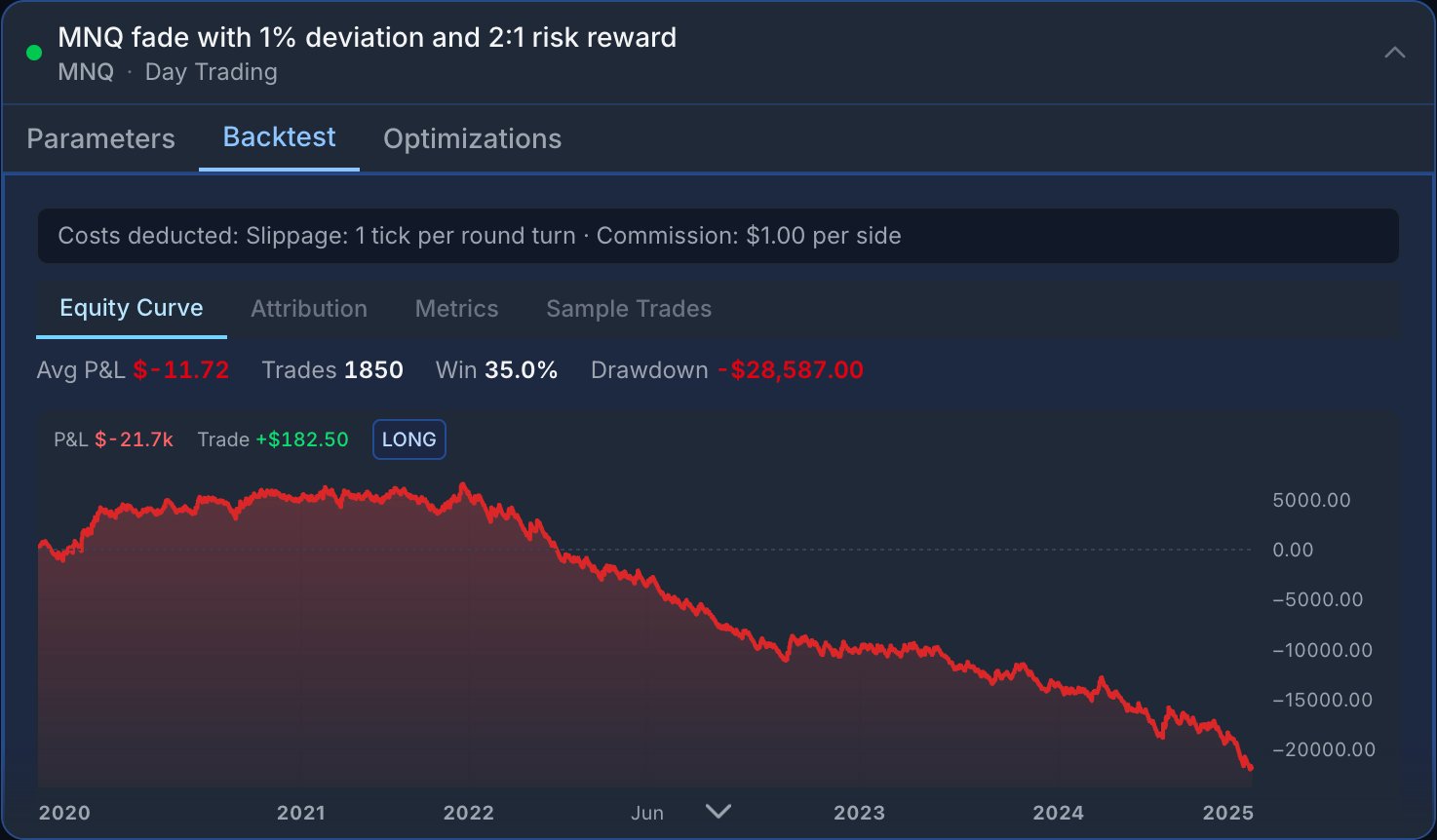
The equity curve
The chart at the top is your equity curve — cumulative P&L over the test window, trade by trade. It’s the fastest read on the whole strategy: where it made money, where it gave it back, and how smooth the ride was. What to look for:- Up and to the right, steadily. A line that climbs without giant cliffs is the healthy shape. Steady beats spiky.
- One trade or one week carrying everything. If a single vertical jump is doing all the work, the edge may not be real or repeatable.
- Long flat or sliding stretches. These are the periods you’d have had to sit through. Map the worst slide to Max Drawdown below.
Headline metrics
Right under the curve are the five numbers that summarize the run. Read them together — no single one tells the story.Trade Count
How many trades the rules generated. Concerning: very low (a handful —
too few to trust) or very high (over-trading, where costs eat the edge).
Total P&L
Net profit or loss across all trades, after modeled slippage and commission.
The bottom line — but never read it alone.
Avg P&L / Trade
Total P&L divided by trade count — your per-trade edge. Concerning: a few
ticks either side of zero usually means there’s no real edge once costs are
paid.
Win Rate
Share of trades that closed profitable. Watch out: a high win rate alone
doesn’t mean profitable — many small wins and a few large losses still lose.
Max Drawdown
The largest peak-to-trough drop in cumulative P&L — the worst stretch you’d
have sat through. This is your pain-tolerance check, not an afterthought.
Extended metrics
Ask for more — “show me the extended metrics” — and AskFutures surfaces the deeper breakdown. This is where you find out how the strategy made (or lost) its money.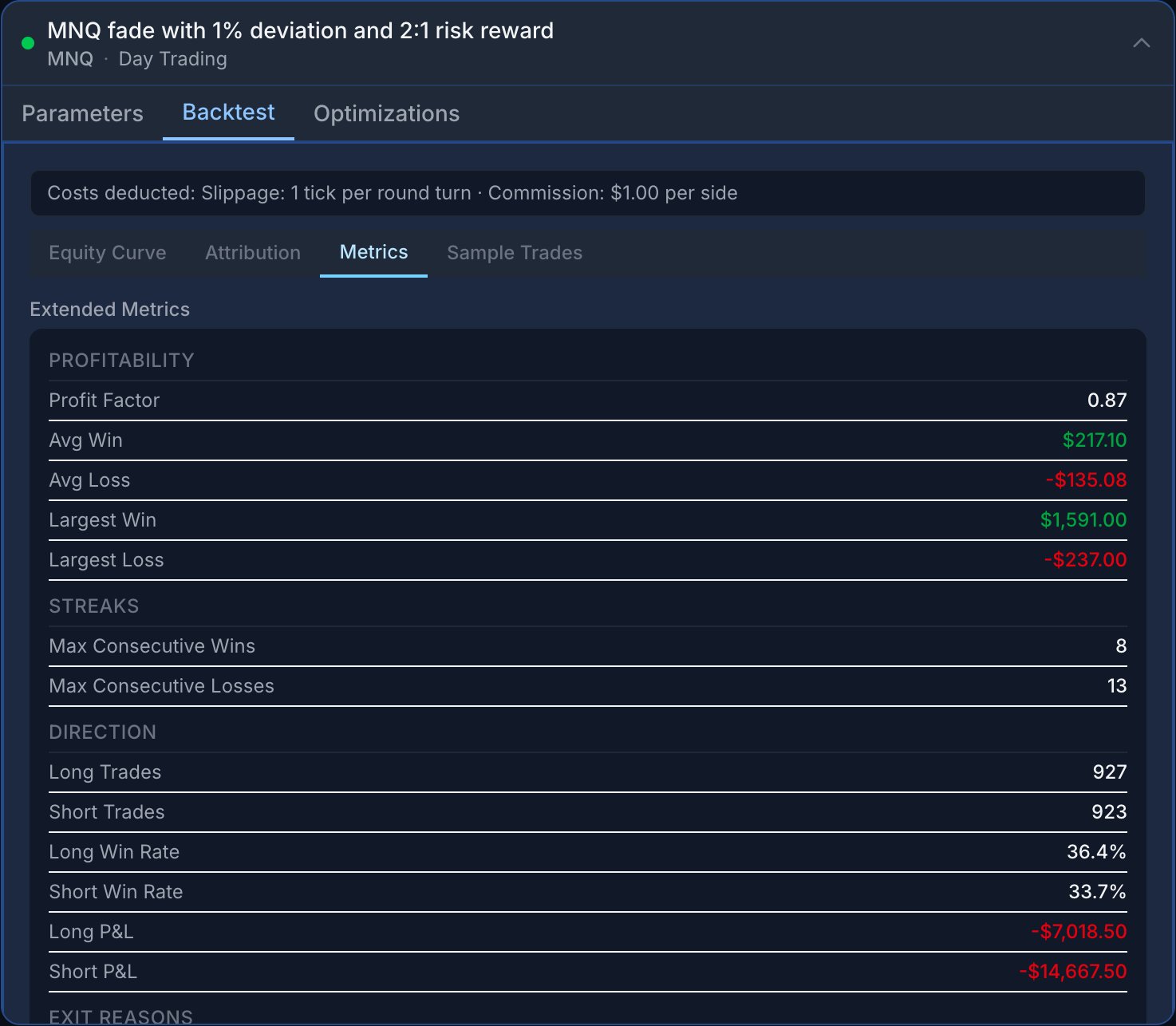
Profit Factor
Profit Factor
Gross profit divided by gross loss. Above 1.0 means the wins outweigh the
losses; the further above 1.0, the more cushion. A factor right around 1.0 is
a coin flip once you account for real-world frictions the simulator doesn’t
capture.
Average win vs. average loss
Average win vs. average loss
The typical winning trade against the typical loser. Pair this with win rate:
a low win rate can still be very profitable if winners dwarf losers (a trend
strategy), and a high win rate can still bleed if a few losers are huge.
Long / short split
Long / short split
Performance broken out by direction. Concerning: if all the profit comes
from longs and the shorts lose, you may really have a long-only edge wearing
a two-sided costume. Consider restricting direction — “make it long-only.”
Average hold time
Average hold time
How long the average trade stayed open. Check it matches your intent — a
“day-trading” idea showing multi-day holds (or a swing idea closing in
minutes) means a rule isn’t doing what you thought.
Exit-reason breakdown
Exit-reason breakdown
How often trades left via each exit:
stop, target, trailing_stop,
time, session_close, or signal. If almost everything exits on
session_close, your stop and target may be too wide to ever trigger; if
stop dominates, they may be too tight. This is the fastest way to see
whether your risk rules are actually
shaping trades.The sample trade chart
AskFutures can show a representative trade plotted on price — entry, exit, and the levels that mattered (stop, target, the indicator that fired). It turns the numbers into a picture you can gut-check.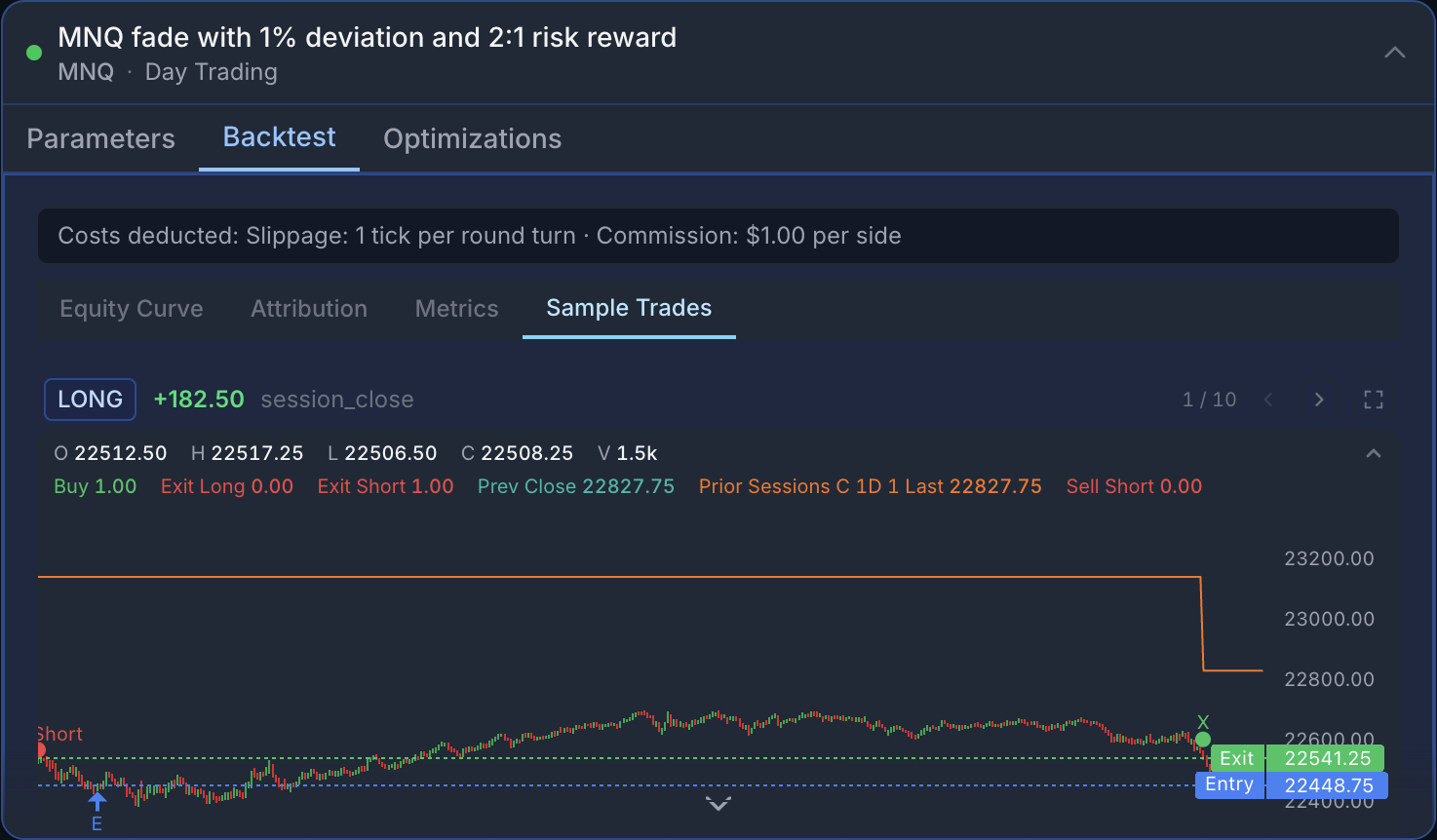
P&L attribution
Attribution answers “where did the money actually come from?” — sliced by direction, by exit reason, and across time. It’s how you tell a robust edge from a lucky one.- By direction — longs vs. shorts (see the split above). Lopsided profit is a flag.
- By exit reason — are targets carrying the strategy, or is it just dodging
losers with stops? Profit that lives entirely in
targetexits is fragile if the target is finely tuned. - Across time — does it earn consistently, or did one quarter make the year? The equity curve is the visual version of this.
”Good” vs. “concerning” at a glance
A high-level read — not rules, just patterns worth a second look.Next steps
Iterate and refine
Don’t like a number? Change one rule and re-run.
Optimize a strategy
Sweep the tunable numbers to find better settings.
Metrics glossary
Exact definitions of every metric above.
Is the backtest real?
Why these numbers are reproducible — and what they don’t model.