A one-rule mean-reversion strategy on Micro Nasdaq — no indicators — then narrowed to the morning session.
The hypothesis: a sharp 1% drop often creates temporary selling pressure.
Buying Micro Nasdaq at that point is basically buying fear and betting on
mean reversion — that prices bounce once the panic fades. The point isn’t to
guess from the chart; it’s to see whether the rule survives a real backtest.This is the simplest strategy in the tutorials: no indicators, no chart
patterns — just one rule. If Micro Nasdaq closes 1% below yesterday’s close,
buy it.
Past performance does not guarantee future results. Always test before you trade.
Open askfutures.com and sign in. New here? Create
an account and start your free trial first — the
quickstart covers sign-up.
A fresh chat, ready for your idea.
Describe the one rule
Paste this prompt exactly and send it:
Your prompt
Buy MNQ when 1 minute bar close is at least 1% below the previous day close
That’s the whole idea — one entry rule. Because this is a day-trading idea,
AskFutures applies its defaults (last 1 year, 1-minute bars) and adds an
end-of-day exit, so any open trade closes at the session close. It tells
you what it assumed.
Watch the strategy card appear
AskFutures writes your sentence down as exact rules. The strategy card
shows a single entry — a 1-minute close at least 1% below the previous day’s
close — with no indicators attached, plus a Strategy Flow chart. See
strategies for how the pieces fit.
The strategy card: one rule, no indicators.
Read the backtest
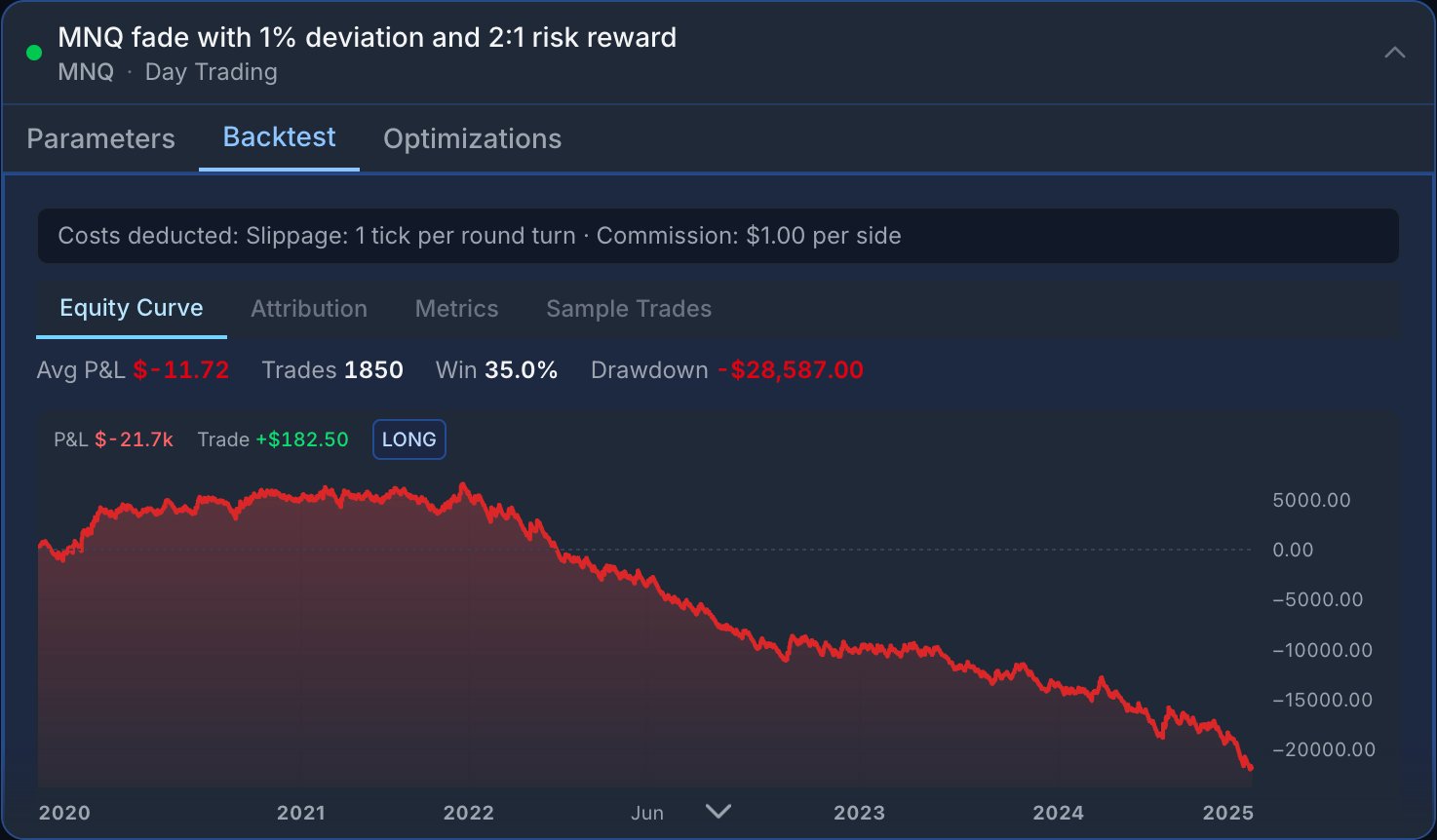
The backtest tab shows the equity curve and headline numbers — net P&L, win
rate, and drawdown — over the last year, net of modeled slippage and
commission. The real question: does buying the fear show any mean-reversion
edge once the pressure fades? Read the equity curve, not just the bottom
line. See run and read a backtest.
The backtest tab: equity curve and headline metrics.
Refine: morning only
Liquidity and emotional follow-through are often strongest near the open. Test
whether the edge is concentrated in the morning by adding a time-of-day
filter — send this:
Refine it
Only take the trade between 9:30 and 11:00 AM
AskFutures keeps the same one rule and adds the time filter as a new saved
version. Compare the morning-only run against the all-day run: is the edge
really concentrated near the open, or just spread thinner? See
version and compare.
The refined version, restricted to the 9:30-11:00 window.
These results are hypothetical and simulated — no real trades were placed.
Because no order actually hit the market, results may under- or over-state live
outcomes. Past performance, actual or simulated, does not guarantee future
results. Always test before you trade.
You tested a complete idea with a single rule and no indicators, then asked a
sharper question — is the edge in the morning? — with one more sentence. That’s
the power of the loop: start as simple as one rule, then refine until the idea
earns your trust.