Build and read a 15-minute opening-range breakout on Micro Nasdaq, screen by screen, then refine it with one sentence.
Let’s build a real strategy together: a 15-minute opening-range breakout on
Micro Nasdaq (MNQ). The idea is simple and popular — many traders believe the
first 15 minutes of the session hint at where the market wants to go for the
rest of the day. We’ll describe it, read the backtest, then add one filter and
watch the result change.
Past performance does not guarantee future results. Always test before you trade.
Open a new chat
Sign in at askfutures.com and start a new chat. If
you haven’t started your trial yet, the
quickstart covers sign-up in two steps.
A fresh chat, waiting for your idea.
Describe the breakout in plain English
Type the idea exactly as you’d say it out loud:
Prompt
Buy Micro Nasdaq when price breaks above the first 15-minute high,and exit if it closes back below the midpoint of that range
Send it. Notice what you didn’t specify — no bar size, no date range, no
direction. AskFutures fills those in with sensible defaults and tells you
what it assumed.
Read the strategy card
AskFutures turns your sentence into a precise, rule-based strategy. On the
strategy card you’ll see it written out:
Market: Micro Nasdaq (MNQ)
Entry: buy when price breaks above the high of the first 15-minute
range
Exit: close if price closes back below the midpoint of that range
Strategy Flow: a chart of the logic, so you can see the rules connect
Because this is a day-trading idea, AskFutures also adds an end-of-day
exit — any open trade is closed at the session close rather than held
overnight. That’s one of the assumptions it states for you.
Your idea, written out as exact rules plus a Strategy Flow chart.
Read the backtest
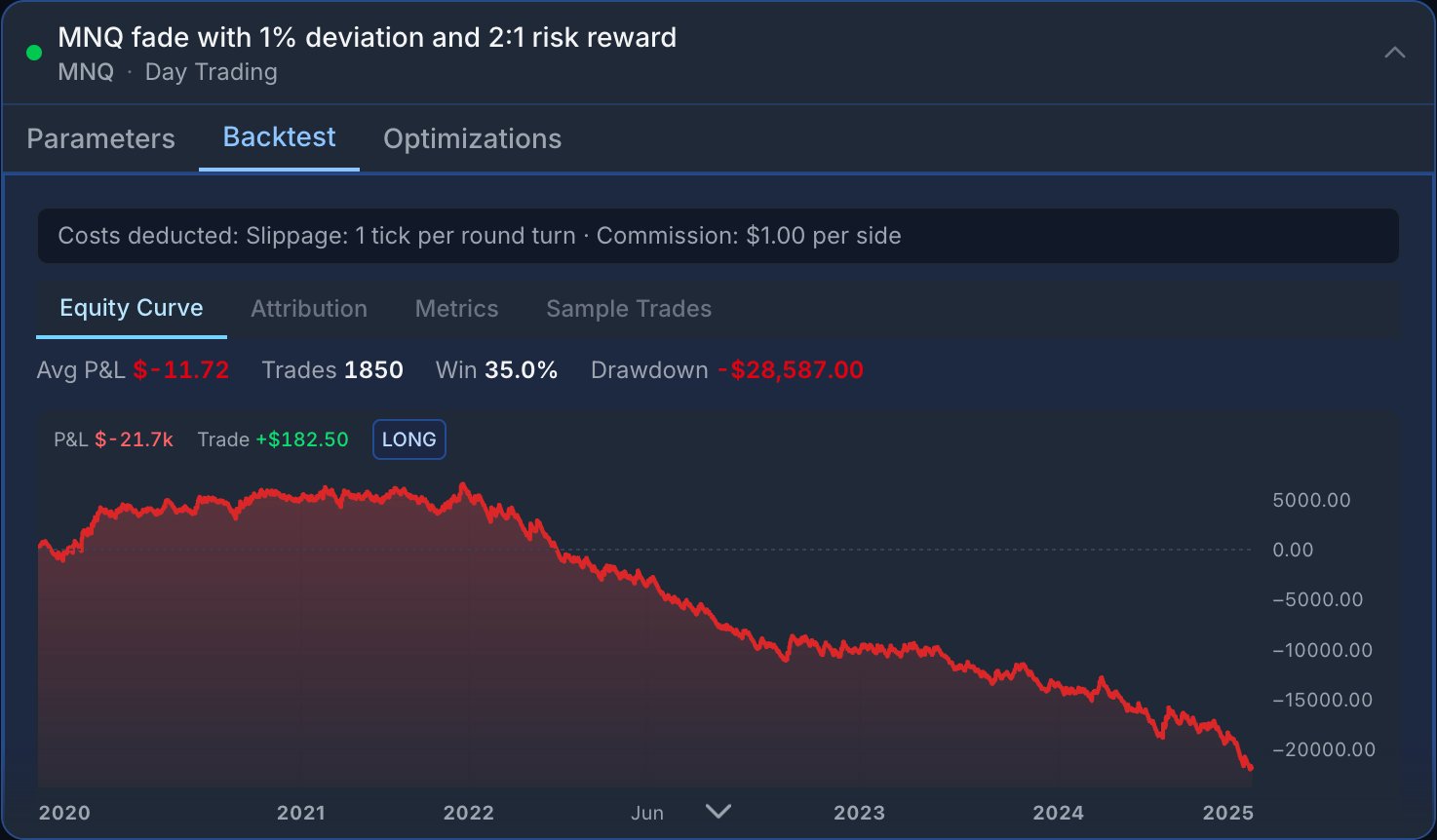
AskFutures runs the strategy through a fixed, deterministic backtest over the
last year of real 1-minute prices and shows you the equity curve plus the
headline numbers — net of modeled slippage (1 tick) and commission. The
equity curve is your at-a-glance read: a line drifting up means the rule made
money over the period; chop or a slide downward tells you the opposite.
The backtest: equity curve and headline metrics for the base breakout.
These results are hypothetical and simulated — no real trades were
placed, and simulated programs are designed with the benefit of hindsight.
Past performance, actual or simulated, does not guarantee future results.
Always test before you trade.
Refine it with one sentence
Here’s the part that makes AskFutures feel like a conversation. The thinking:
a small opening range might just be noise, while a large range can signal
stronger intent — so maybe we only want to trade the bigger ranges. Tell it
so, in plain English:
Refinement
Trade only if the opening range is over $400
Send it. AskFutures adds the filter — keeping the same entry and exit — and
saves it as a new version, then reruns the backtest automatically. The
new equity curve appears beside the old one so you can judge whether the
filter actually helped.
The filtered version reruns automatically, side by side with the original.
In a few sentences you built a complete strategy, backtested it on real data,
and refined it — without writing a single line of code. The AI only translated
your words into rules; every number came from the same deterministic engine, so
the same rules on the same data always produce the same result. That’s the whole
loop: describe, strategy, backtest, iterate.From here you can keep going — add a stop, widen the date range, swap MNQ for a
different market, or optimize the $400 threshold to see
which value held up best.