Build a 15-minute opening-range breakout on Micro Nasdaq, then refine it to trade only when the range is wide.
The hypothesis: many traders believe the first 15 minutes of the session set
the tone for the day. A break above that opening range can signal real intent —
and a small range might just be noise, while a wide one suggests stronger
conviction. In this beginner tutorial you’ll build that breakout, backtest it,
then add one filter that only trades on a wide opening range.
Past performance does not guarantee future results. Always test before you trade.
Open askfutures.com and sign in. New here? Create
an account and start your free trial first — the
quickstart walks through it.
A fresh chat, ready for your idea.
Describe the breakout
Paste this prompt exactly and send it:
Your prompt
Buy Micro Nasdaq when price breaks above the first 15-minute high,and exit if it closes back below the midpoint of that range
You don’t have to mention bars, dates, or directions. Because this is a
day-trading idea, AskFutures applies its defaults — last 1 year, 1-minute
bars — and adds an end-of-day exit, so any open trade closes at the
session close. It tells you each assumption it made.
Watch the strategy card appear
AskFutures turns your sentence into precise rules. The strategy card shows
the entry (a break above the first 15-minute high), the exit (a close back
below the range midpoint), and a Strategy Flow chart of the logic. See
strategies for what each part means.
The strategy card: your idea as exact rules, plus a flow chart.
Read the backtest
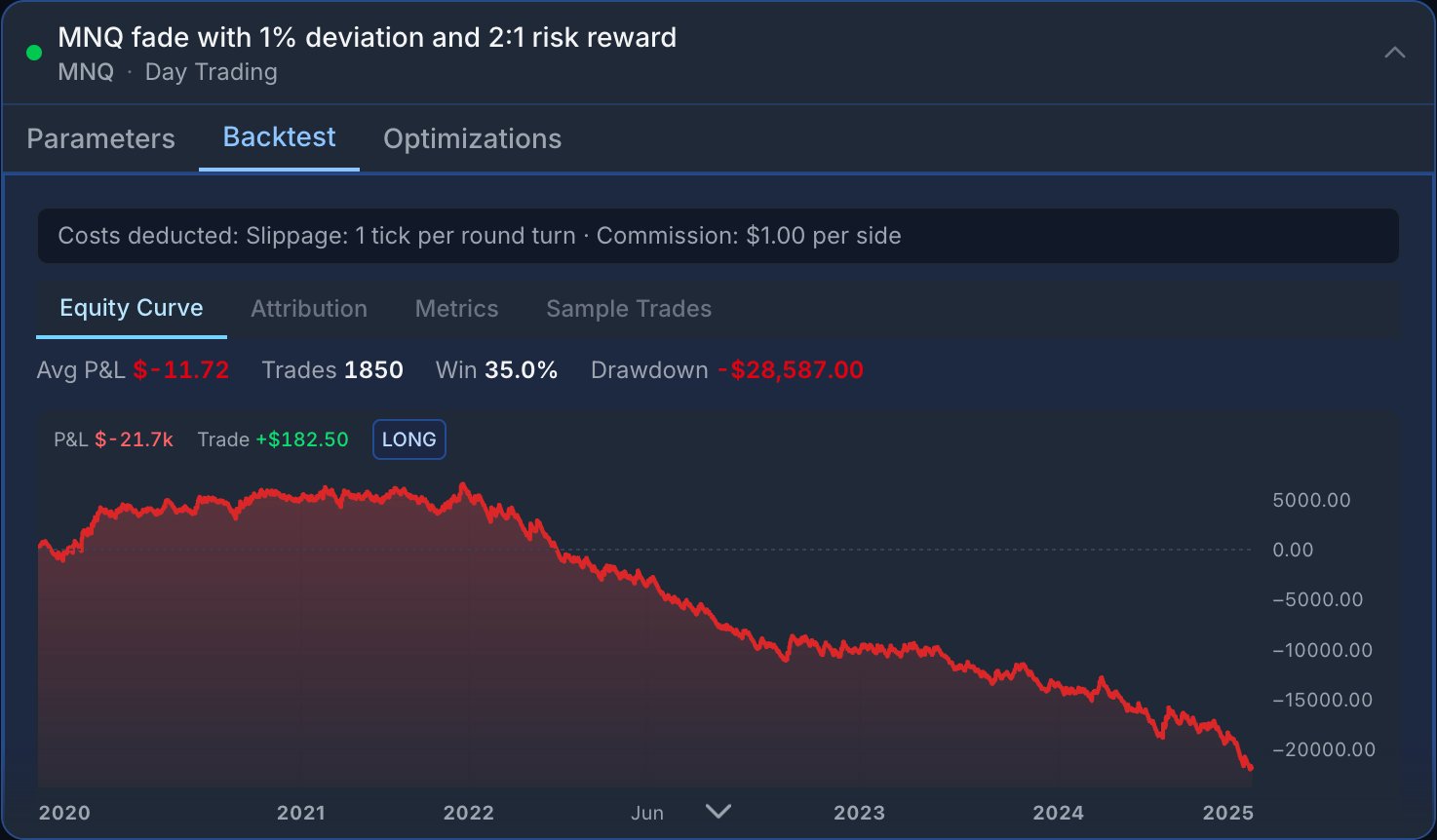
The backtest tab shows the equity curve and the headline numbers — net P&L,
win rate, and drawdown — over the last year of real prices, net of modeled
slippage and commission. Look at the shape of the equity curve, not just the
final number: is it a steady climb or a few lucky days? See
run and read a backtest.
The backtest tab: equity curve and headline metrics.
Refine: only trade a wide range
Now test the “intent” idea. A small opening range might be noise; a wide one
suggests the move has fuel behind it. Add one filter — send this:
Refine it
Trade only if the opening range is over $400
AskFutures keeps everything else and adds the filter as a new saved version.
Compare the two equity curves: did filtering for a wide range thin out the
noise, or just cut your trade count? See
version and compare.
The refined version, filtered to wide opening ranges only.
These results are hypothetical and simulated — no real trades were placed.
Because no order actually hit the market, results may under- or over-state live
outcomes. Past performance, actual or simulated, does not guarantee future
results. Always test before you trade.
You took one plain-English sentence to a full strategy and backtest, then tested
a hypothesis — wide ranges show intent — by adding a single filter and
comparing. That Describe -> Strategy -> Backtest -> Refine loop is the whole game.