

Editing is non-destructive. “Add a 1.5× ATR stop,” “make it longs only,”
“switch to 5-minute bars” — each becomes a fresh version built from the
current one, not an overwrite. See
sessions, versions and artifacts.
How a version chain builds up
Each strategy is a chain of versions, newest at the tip. When you ask for a change, AskFutures branches a new version off the latest one.Step through versions
The strategy card shows which version you’re viewing and lets you move through the chain. Step back to any earlier version to see its exact rules and its own backtest results — nothing recomputes, because each version keeps the numbers it ran with.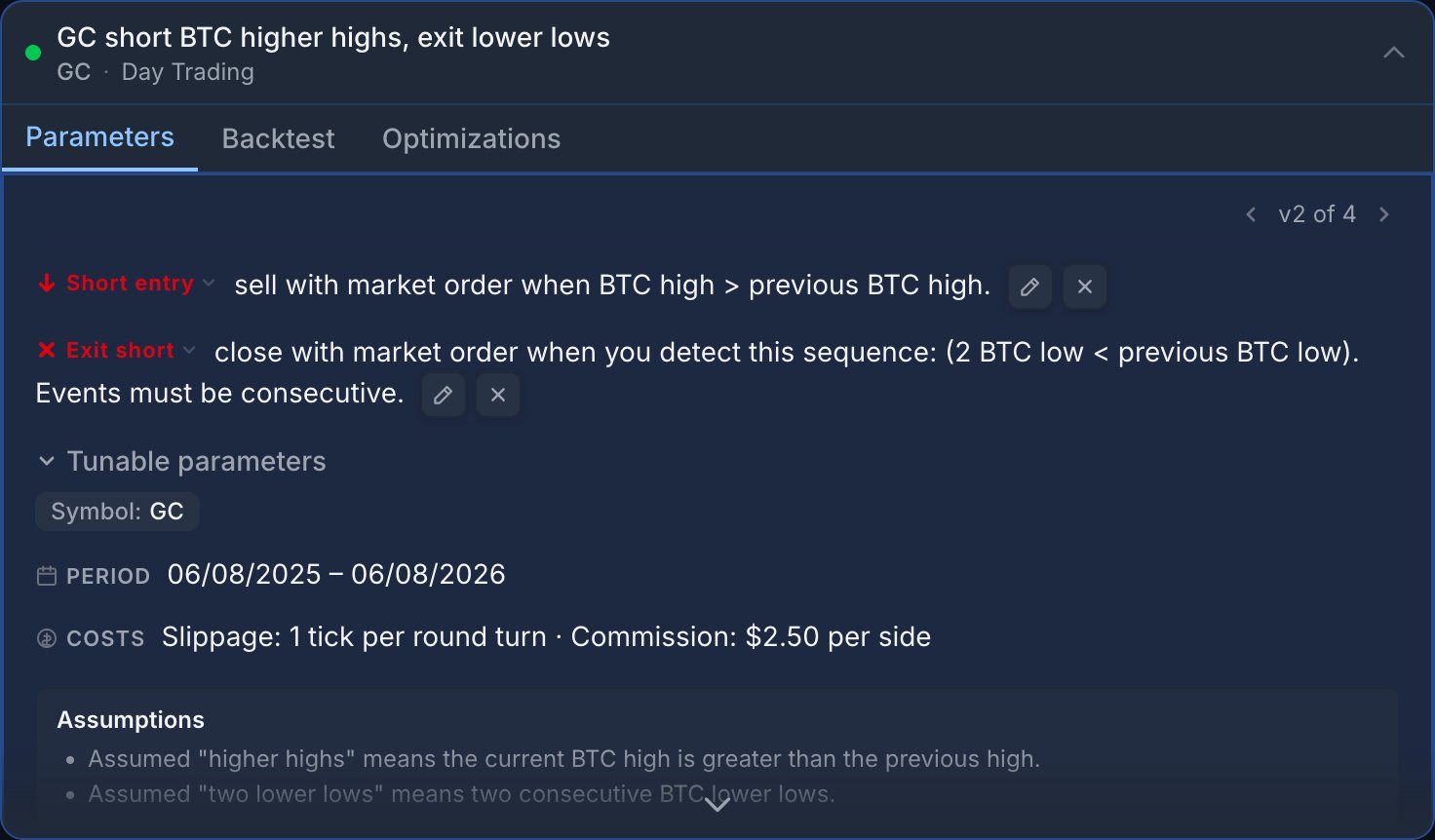
The version selector on the strategy card: step back and forth through every saved edit.
Compare metrics across versions
Because a backtest is pinned to the exact version it ran on, comparing is apples to apples — you never see numbers from one set of rules sitting next to a different set by accident.1
Run a backtest on each version you want to compare
Every version carries its own results. If an older version was never
backtested over the window you care about, re-run it so both share the same
period.
2
Line up the headline metrics
Put the versions side by side and read across — total P&L, average P&L per
trade, win rate, max drawdown, number of trades. Ask AskFutures to summarise
the comparison if you’d rather read it in plain English.
3
Judge the change, not just the score
A higher total P&L from far fewer trades is a different bet than a steadier
edge across many. Look at drawdown and trade count, not only the top-line
number.
Compare apples to apples
The engine is deterministic, so the same
version over the same data always reproduces the same numbers. One caveat: the
market data refreshes daily, so re-running a relative period like “last 1
year” can include newer bars. To compare two versions cleanly, run both over
the same explicit date window.
Revert by continuing from an older version
There’s no destructive “undo” — and you don’t need one. To go back, just step to the version you liked and continue from there. Your next edit branches a new version off that older one; the versions you’re leaving behind stay untouched, so nothing is lost either way.An edit made things worse — how do I get back?
An edit made things worse — how do I get back?
Step back to the version before the edit and keep working from it. The new
version you create branches off the good one; the worse version stays in the
chain but out of your way.
Will reverting delete the versions I'm skipping?
Will reverting delete the versions I'm skipping?
No. Continuing from an older version is non-destructive — every version stays
exactly as it was, including its backtest results. You can always step forward
again.
Does 'version' mean the AskFutures release?
Does 'version' mean the AskFutures release?
No. Here, version always means a saved snapshot of your strategy in its
edit chain (v1 → v2 → v3). It has nothing to do with the product release or
any internal engine version.